For the first time in the history of the internet, you are the minority.
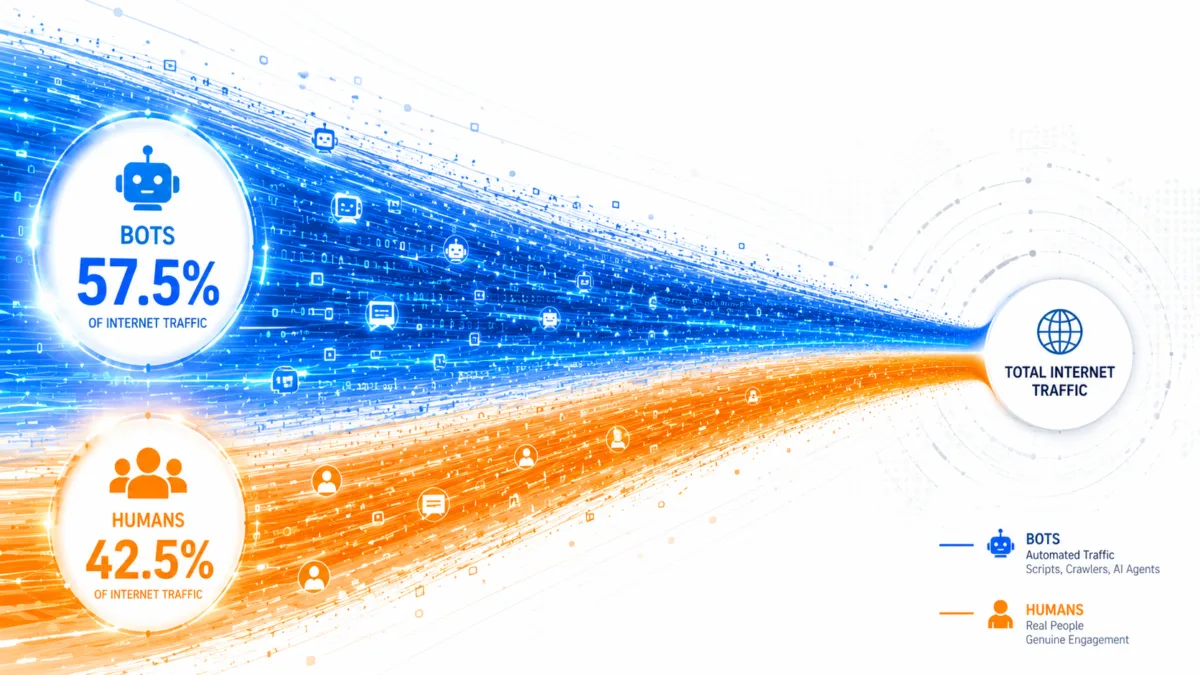
According to new data from Cloudflare — which handles security and content delivery for millions of websites — automated systems now account for more than half of all HTTP requests on the web. Bots have officially outnumbered humans online.
The number isn’t close. Bots currently make up 57.5% of all internet traffic. Real users account for the remaining 42.5%.
Nobody expected it this soon
Cloudflare CEO Matthew Prince confirmed the milestone with a candor that’s rare in corporate communications: “Well, this happened faster than I expected. I thought it would happen at the end of 2027, then I revised to early 2027 — but bot traffic is growing so fast that for the first time in internet history, bots have surpassed human traffic.”
That’s not a projection being revised after the fact. That’s a CEO watching his own forecasts get overtaken in real time, twice in a row, by a trend that’s still accelerating.
What’s actually driving this
This isn’t the old story of spam bots and scrapers — though those haven’t gone anywhere. The main driver of the current surge is generative AI. Modern AI agents perform tasks on behalf of users by visiting enormous numbers of web pages to search for and analyze information. They compare product prices, look up flights, analyze descriptions, and act as personal assistants — and every single one of those actions creates additional HTTP requests to websites across the web.
Think about what happens when you ask an AI assistant to find you the cheapest flight to Miami. In the background, something is hitting dozens or hundreds of pages to pull that answer together. Multiply that by the number of people using AI tools daily — hundreds of millions — and the math stops being surprising.
What this actually means
The internet was designed for people. Websites are built to be read, navigated, and clicked by humans. Now more than half the traffic arriving at those sites is automated — and that ratio is only going one direction.
For publishers, the implications are already uncomfortable. If a growing share of your traffic is AI agents reading your content to power someone else’s answer, the traditional metrics of web analytics start to mean something different. Pageviews, sessions, bounce rates — all of them quietly shifting in meaning as the composition of “visitors” changes.
For the web itself, the deeper question is what it looks like when machines are the primary audience. Content gets written, sites get built, and infrastructure gets maintained — mostly for systems that will summarize and abstract it before a human ever sees it. The internet is increasingly a machine talking to machines, with humans occasionally checking in to see what they found.
That’s not a dystopia, necessarily. But it’s a pretty significant structural shift for something that was supposed to connect people.