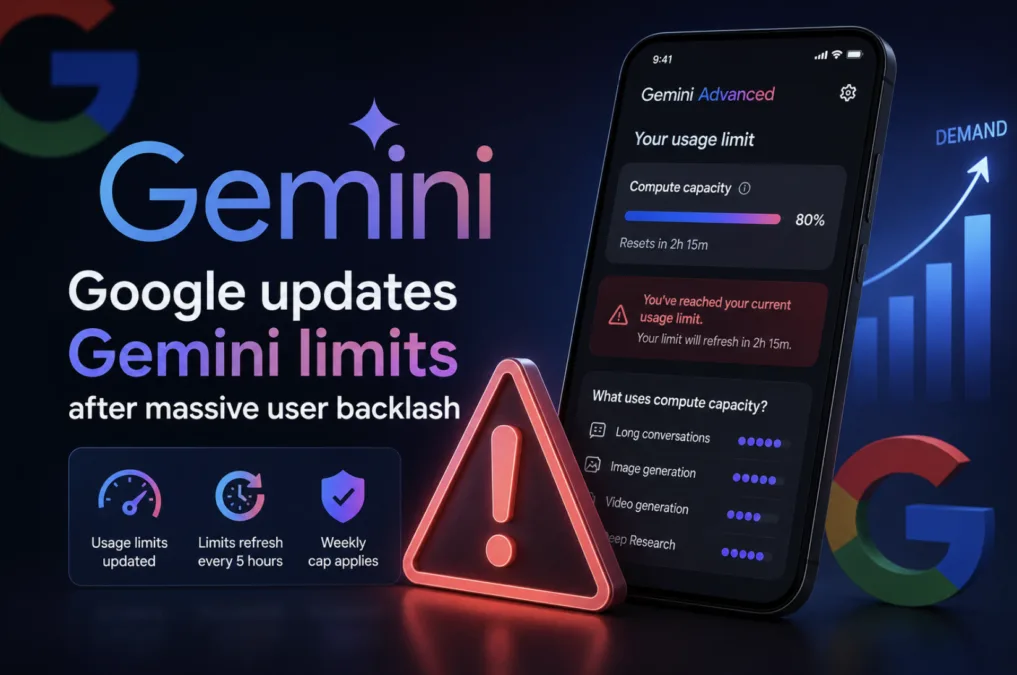
Google has started adjusting its controversial new Gemini usage limits after a wave of criticism from paying subscribers and power users. The company recently moved away from its previous fixed-message system and introduced a new compute-based quota model, but many users quickly reported that the change made Gemini far more restrictive than before.
The backlash became so widespread that Google appears to be increasing limits and investigating complaints from users who claimed they exhausted their allowance after only a handful of prompts — in some cases, after just a single AI task.
What Changed With Gemini?
Instead of counting how many prompts a user sends, Gemini now measures usage based on computing resources consumed. That means the complexity of a request, the length of a conversation, image generation, video creation, Deep Research, and other advanced AI features all impact how quickly a user’s quota is depleted.
Google says the new system is designed to better reflect actual AI processing costs.
Under the updated model:
- Simple text requests consume relatively little capacity.
- Long conversations use more resources.
- AI-generated images and videos consume significantly more quota.
- Limits refresh every five hours before eventually reaching a weekly cap.
For Google AI Pro subscribers, usage allowances are higher than on the free tier, but many paying customers still reported hitting limits much faster than expected.
Users Were Not Happy
The reaction across Reddit, Google’s own forums, and social media was immediate.
Many users complained that the new quota system feels unpredictable because there is no simple way to know how much capacity a specific request will consume. Others argued that the limits became noticeably stricter despite paying for premium access.
One widely shared example involved a Google AI Pro subscriber who reportedly exhausted an entire five-hour quota after attempting a single AI-generated video request. The generation ultimately failed, yet the user’s available capacity was still consumed. Google acknowledged the complaint publicly and said it would investigate the issue.
Google Is Already Adjusting Limits
Following growing criticism, Google appears to be gradually increasing some usage caps and refining the system. Reports indicate that certain Gemini models have already received higher allowances compared to the initial rollout period.
The company has not announced a complete reversal of the new policy, but the response suggests Google recognizes that the launch created frustration among some of its most active users.
The challenge for Google is balancing user expectations with the enormous infrastructure costs required to run advanced AI systems. Features such as multimodal reasoning, video generation, and long-context conversations require dramatically more computing power than traditional chatbot interactions.
The Bigger AI Trend
Google is not alone in moving toward usage-based AI limits.
As AI models become more powerful — and more expensive to operate — major companies are increasingly introducing credit-style systems that measure actual resource consumption rather than simple prompt counts. Similar approaches are already being used across multiple AI platforms.
For users, this signals the end of the era where advanced AI tools felt virtually unlimited.
Instead, the future may involve monitoring AI usage much like cloud storage, mobile data plans, or streaming subscriptions.
What Gemini Users Should Expect Next
For now, Gemini subscribers should expect Google to continue tweaking quotas as real-world usage data arrives. The company is under pressure to make the system more transparent and predictable, especially for paying customers who rely on Gemini for work, research, and content creation.
While Google has already begun responding to complaints, the controversy highlights a growing reality across the AI industry: the most powerful AI experiences are becoming increasingly tied to computing costs, and unlimited access may soon become a thing of the past.