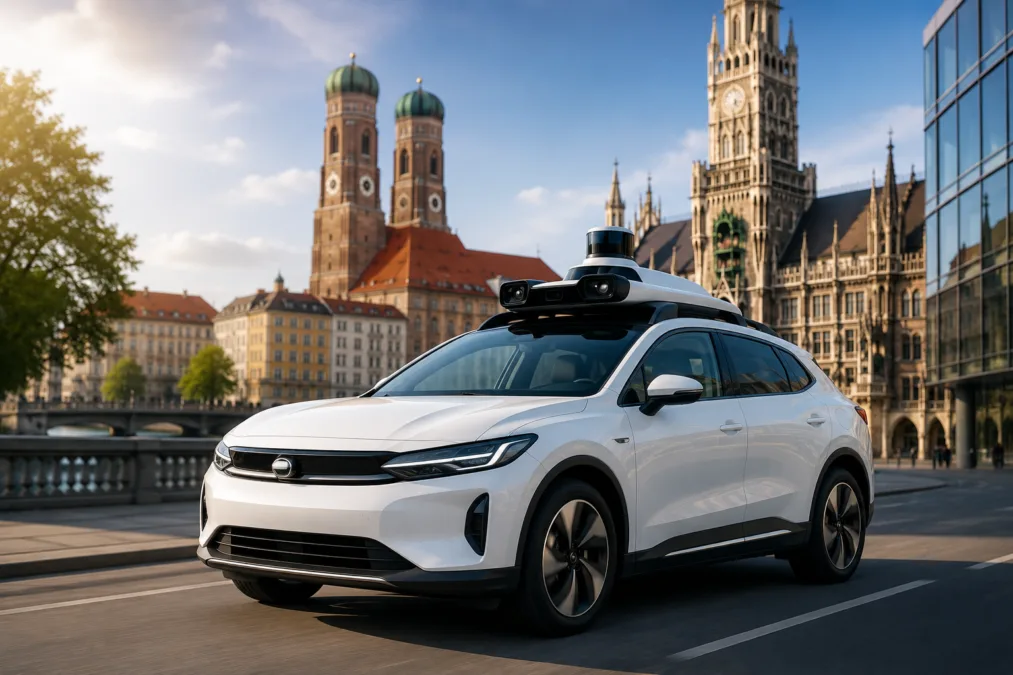
The race to bring fully autonomous taxis to European streets is accelerating. German startup Autobrains has announced a new robotaxi initiative in Munich, supported by both Uber and Nvidia.
The project aims to develop self-driving vehicles capable of operating in real urban environments, marking another major step toward commercial autonomous transportation.
Munich Becomes a Testing Ground
The new program will focus on deploying autonomous vehicles in and around Munich, one of Germany’s leading technology hubs.
Developers hope the city will provide valuable real-world driving data, allowing autonomous systems to learn how to handle complex traffic situations, pedestrians, cyclists, construction zones, and unpredictable urban environments.
Nvidia Provides the AI Power
At the heart of the project is Nvidia’s autonomous driving technology.
Modern robotaxis rely on enormous amounts of computing power to process information from cameras, sensors, radar systems, and mapping tools in real time.
Nvidia’s AI platforms have become a key component of many autonomous vehicle projects around the world.
Uber Continues Its Self-Driving Ambitions
Although Uber sold its original autonomous driving division several years ago, the company has continued investing in self-driving partnerships.
The latest collaboration reflects Uber’s belief that autonomous vehicles will eventually become a major part of its transportation network.
The company sees robotaxis as a way to lower operating costs and expand mobility services in the future.
Why Europe Matters
Most robotaxi deployments have taken place in the United States and China.
Europe has generally moved more cautiously because of stricter regulations and complex urban environments.
A successful deployment in Germany could help accelerate adoption across the continent and provide a blueprint for future autonomous transportation services.
The Competition Is Heating Up
The autonomous vehicle industry is becoming increasingly crowded.
Major players include:
- Waymo
- Tesla
- Baidu Apollo
- WeRide
- Pony.ai
- Zoox
- Mobileye
Many companies believe robotaxis could eventually transform urban transportation by reducing costs and improving accessibility.
Challenges Still Remain
Despite rapid advances in artificial intelligence, fully autonomous driving remains one of the most difficult technological challenges.
Developers must overcome issues related to:
- Safety
- Weather conditions
- Regulatory approval
- Public trust
- Infrastructure compatibility
Even the most advanced systems still require extensive testing before large-scale deployment.
The Munich project highlights how quickly autonomous vehicle technology is moving from research programs to real-world deployment.
With support from Uber and Nvidia, the initiative could become one of Europe’s most closely watched robotaxi experiments.
If successful, it may help bring fully autonomous ride-hailing services closer to everyday reality and reshape how people move around cities in the coming years.