Forget the app grid. Microsoft thinks the future of personal computing clips onto your shirt pocket.
At Computex 2026, Microsoft pulled back the curtain on something nobody really saw coming — not a new Surface, not another Copilot button, but a wearable AI badge the size of a corporate ID card that runs on Android and packs 5G, a camera, a fingerprint sensor, and a microphone array. They’re calling the whole thing Project Solara, and the pitch is straightforward, if a little ambitious: apps had their moment. Now it’s the agents’ turn.
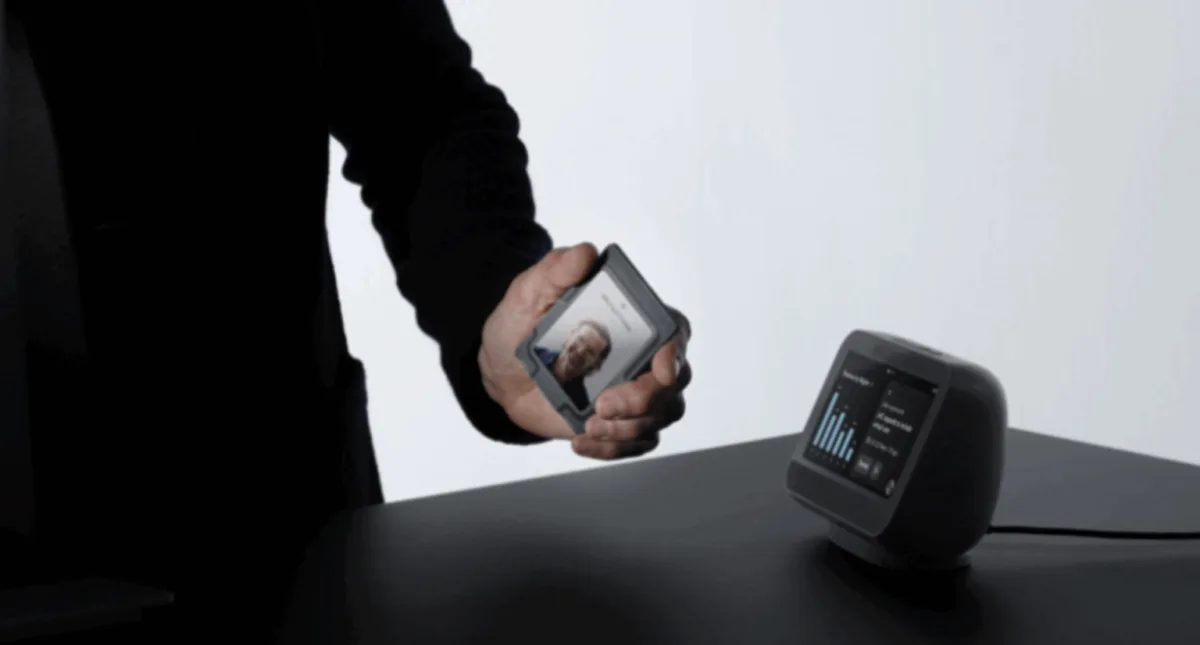
Microsoft showed Solara running on two reference devices — a desk-based smart display that looks like an Amazon Echo Show, and a portable smart badge designed to go wherever you go. The display is fine. The badge is the interesting part.
What the Badge Actually Does
The badge packs a touchscreen, a Hello fingerprint sensor, a far-field mic array, a speaker, a side-facing camera, and support for WiFi, Bluetooth, 5G, and even satellite connectivity — all running on Qualcomm wearable silicon. It’s less a phone and more a dedicated AI terminal you wear. Glance at your next meeting, tap to record and transcribe a conversation in real time, ask a question hands-free while your hands are full. That’s the idea.
Microsoft describes it as reimagining the corporate access badge — the thing nurses, retail workers, and office staff already clip on every day — as an always-connected AI companion. Which is either genius product thinking or a very long way around to building a smaller phone, depending on how you look at it.
Android, Not Windows. That’s the Real Story.
Here’s what nobody expected: the whole platform runs on Android, not Windows. Microsoft has quietly been building Project Solara on AOSP — the open-source base of Android — with enterprise security layered on top through Intune and Entra ID. For a company that spent a decade trying to make Windows work on mobile, betting the future of AI hardware on Google’s OS is a striking pivot.
Microsoft’s reasoning is blunt: the current app-launcher model of smartphones may simply be too cumbersome for the era of active AI agents. Why tap through five apps when an agent can just handle it?
Who Is This Actually For?
Right now? Enterprise. Microsoft is preparing to kick off pilot testing with companies in healthcare, retail, hospitality, financial services, legal, industrial, and field services. Think nurses scanning patient wristbands, warehouse workers pulling up inventory, hotel staff checking guests in — all without fishing a phone out of a pocket.
In one demo, the badge scanned a brainstorm board and suggested adding plants to an office redesign. In another, it helped a healthcare worker pull up patient data on the spot. Useful? Absolutely. Ready for the rest of us? Not quite yet.
The bigger question is whether this is Microsoft planting a flag in a territory that doesn’t fully exist yet, or whether they’re genuinely ahead of the curve. Either way, the smartphone just got its first real conceptual challenger from Redmond — and it’s the size of a bus pass.