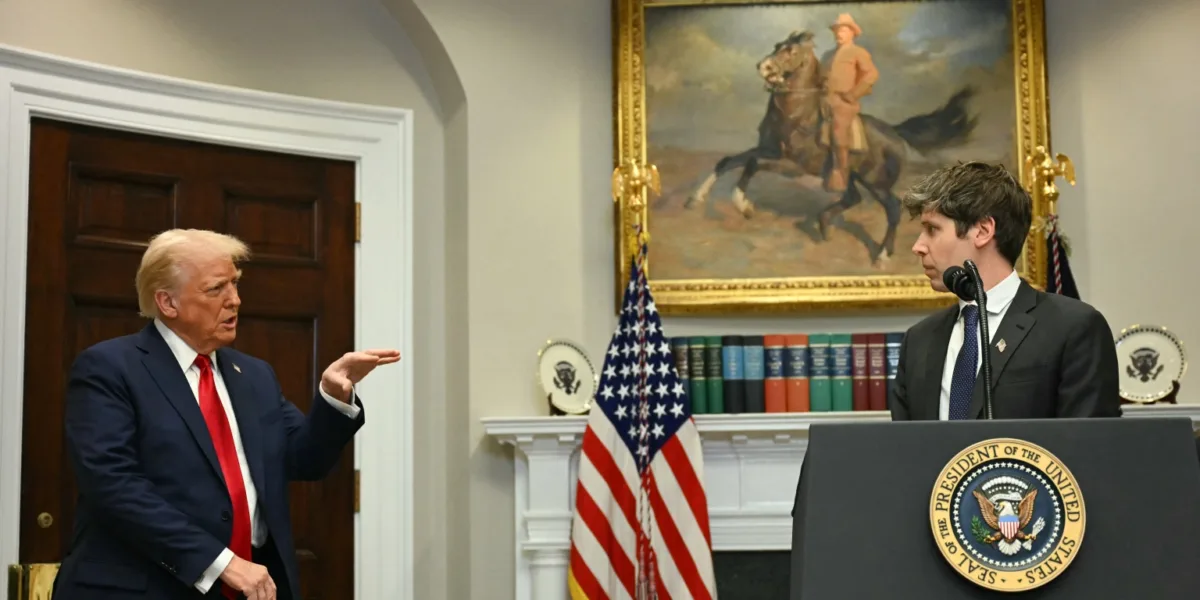
Sam Altman has been pitching this idea to the White House for over a year. Last Friday, Trump confirmed it on Air Force One.
The Trump administration and OpenAI are in active negotiations over a deal that would give the US government a direct equity stake in the company — with the shares going into a proposed Public Wealth Fund designed to distribute AI-driven profits back to ordinary Americans. It sounds like something from a policy think tank fever dream. Except it’s real, it’s been in the works since 2025, and it’s moving fast.
Trump confirmed the talks to reporters aboard Air Force One: “There are concepts where pieces could be given to the American public, where the American public essentially becomes a partner.” He called the idea “very interesting” and said discussions should advance “in the very short, very near future.”
How would this actually work?
Under the proposed framework, OpenAI wouldn’t sell equity to the government — it would donate it. Those donated shares would seed the Public Wealth Fund, which OpenAI outlined in its April 2026 policy paper “Industrial Policy for the Intelligence Age.” The fund would then invest in AI companies and the broader ecosystem, with returns potentially distributed directly to citizens.
OpenAI is currently valued at over $850 billion and is reportedly preparing for an IPO as early as September 2026. The timing matters: any pre-IPO equity commitment by the government would be an unprecedented entanglement of federal financial interests with a single tech company — and at that valuation, even a small stake means serious money.
This wouldn’t be entirely new territory for the administration. Trump has already taken direct equity stakes in Intel, IBM, and other quantum and critical minerals companies during his second term. AI would just be the biggest bet yet.
Bernie Sanders wants 50%. Trump wants something smaller.
Here’s where it gets politically strange. From the left, Senator Bernie Sanders has gone further than the administration — calling for the government to take 50% equity stakes in OpenAI, Anthropic, and xAI, plus a 50% tax on their stock, effectively partial nationalization.
Altman met with Sanders for nearly an hour this week — a meeting Altman himself initiated. While Altman agreed on the principle of public equity in AI, he wouldn’t commit to the 50% figure. Industry advocates are pushing for something far smaller — 1 to 5% contributions to a public fund.
The fact that a Republican president and a democratic socialist senator are both pushing for government ownership of AI companies is genuinely unusual. It signals how far the politics of AI have drifted from the free-market default — and the argument driving both sides is the same: frontier AI models were built partly on decades of publicly funded research, so the public should share in the financial upside.
What about Anthropic and xAI?
Trump mentioned Anthropic and xAI by name when discussing potential government stakes. But a person familiar with the matter said Anthropic is not in equity talks with the administration, following a tense history including a February 2026 order for federal agencies to stop using its technology. xAI — Elon Musk’s company — has not commented publicly.
No official terms have been finalized, and multiple sources say the deal may ultimately not happen. But the conversation itself is already historic — and the outcome could reshape how the US government, the tech industry, and ordinary Americans relate to artificial intelligence for decades.