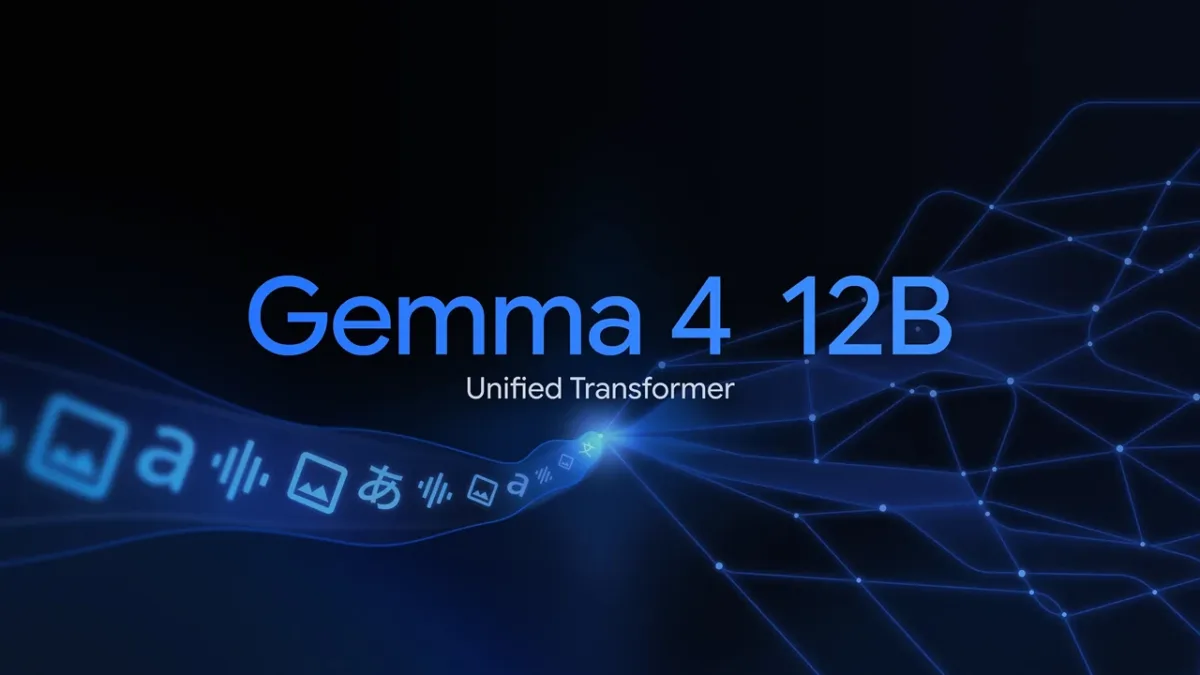
Most AI models that can handle text, images, and audio at once require serious server hardware. Google just made one that fits on a laptop.
Gemma 4 12B is Google’s latest open model — a multimodal AI that processes text, images, and audio natively, and is optimized to run locally on machines with 16GB of RAM or VRAM. That last part is the headline: this isn’t a cloud-only model you ping via API. It’s something developers can download, run offline, and build on without sending a single byte to Google’s servers.
Where it fits in the family
Gemma 4 12B sits between the compact Gemma E4B and the more powerful Gemma 26B. Google claims it delivers performance close to the 26B model while requiring less than half the memory. For developers who’ve been waiting for a middle-ground option that doesn’t require a dedicated GPU workstation, this is the answer.
The Gemma family has clearly hit a nerve. Models from the Gemma lineup have now surpassed 150 million downloads, with developers using them across projects ranging from robotics to enterprise cybersecurity. That’s not a niche research tool — that’s a real ecosystem.
The audio thing is new
Every previous mid-size Gemma model could handle text and images. Audio was left to the bigger, more resource-hungry models. Gemma 4 12B is the first mid-size model in the lineup to support native audio input — and Google did it by eliminating a separate audio encoder entirely. Instead, the model directly projects audio signals into the same processing space used for text tokens.
The same logic applies to images. Rather than running a separate visual encoder, Google replaced it with a simplified data embedding module, shifting the heavy lifting to the language model itself. The result is a leaner architecture that’s less like three models duct-taped together and more like one model that happens to understand multiple kinds of input.
Built for agents, not just chat
Google says Gemma 4 12B is designed for complex multi-step tasks and agentic use cases — scenarios where the model needs to plan, reason across multiple steps, and take actions, not just answer a question. It also supports Multi-Token Prediction, a technique that reduces the delay between when you ask something and when the model starts responding — useful when you’re running everything locally without cloud infrastructure behind you.
This matters because local AI is having a moment. The combination of better chips, more efficient architectures, and models like this one means that running a capable multimodal AI on a decent laptop is no longer a research curiosity — it’s becoming a real workflow. Gemma 4 12B is a meaningful step in that direction.