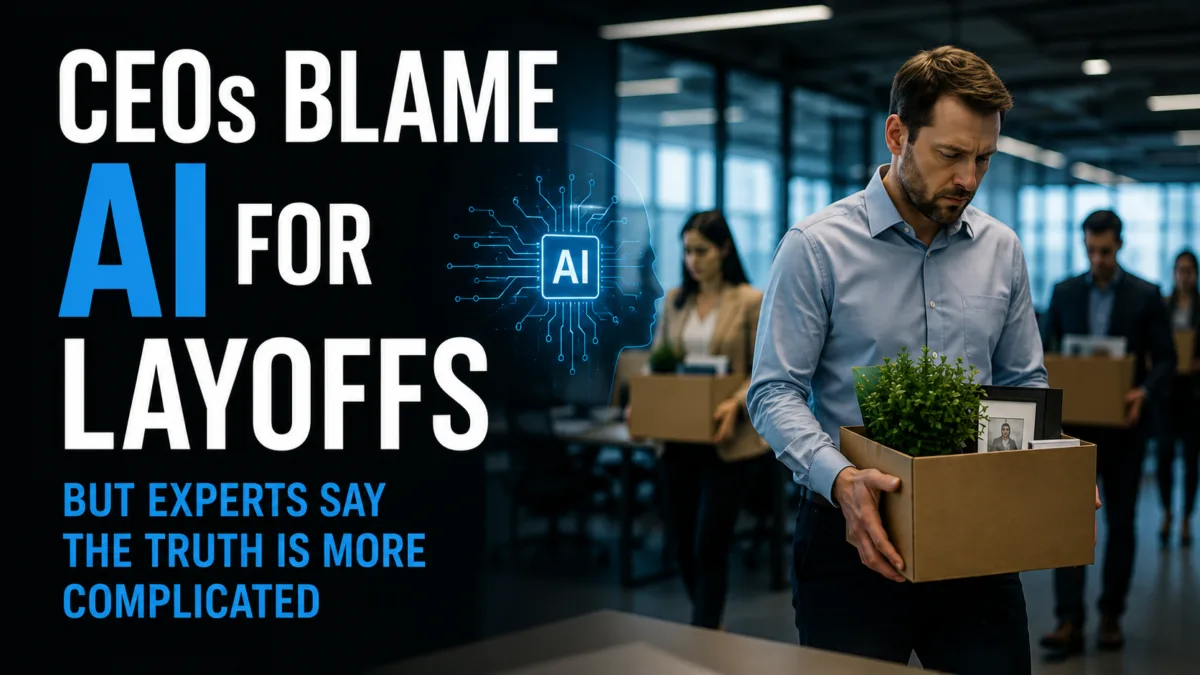
As artificial intelligence continues reshaping the tech industry, a growing number of CEOs have pointed to AI as a reason for job cuts. But according to some experts, the technology may be getting too much of the blame.
A recent discussion sparked by an MIT professor’s comments has reignited debate over whether AI is truly replacing workers – or whether companies are using it as a convenient explanation for broader cost-cutting measures.
AI Has Become the New Corporate Explanation
Over the past year, numerous companies have announced layoffs while simultaneously increasing investments in artificial intelligence.
In many cases, executives have suggested that AI tools allow businesses to operate more efficiently with fewer employees.
That narrative has led many workers to fear that automation could eliminate millions of jobs in the coming years.
The Data Tells a Different Story
Some economists and researchers argue that most recent layoffs cannot be directly linked to AI.
Instead, they point to factors such as:
- Economic uncertainty
- Rising operational costs
- Slower business growth
- Post-pandemic workforce corrections
- Pressure from investors to improve profitability
According to these experts, many organizations were already looking to reduce headcount long before generative AI became mainstream.
AI Is Changing Jobs, Not Necessarily Eliminating Them
While artificial intelligence is undoubtedly affecting the workplace, the impact appears more complex than simple replacement.
Many companies are using AI to assist employees rather than remove them entirely.
Common examples include:
- Writing assistance
- Customer support automation
- Data analysis
- Software development
- Research tasks
- Administrative work
In many cases, workers are becoming more productive rather than being replaced outright.
Why Companies Mention AI
Industry observers say AI has become a powerful narrative for investors.
Businesses that emphasize artificial intelligence often receive significant attention from financial markets, making AI-related announcements attractive from a public relations perspective.
As a result, some critics believe companies may be overstating AI’s role in workforce reductions.
The Real Risk May Come Later
Experts caution that current layoffs do not necessarily reflect AI’s long-term impact.
Today’s AI systems still have limitations, but future models could become far more capable.
As technology improves, automation may begin affecting a wider range of professions, particularly knowledge-based jobs that involve repetitive digital tasks.
The biggest changes may still be years away rather than happening right now.
The debate highlights an important question facing workers, businesses, and governments: how much of today’s workforce disruption is actually being caused by artificial intelligence?
While AI is already changing how people work, many researchers believe recent layoffs are being driven more by traditional business factors than by automation itself.
For now, the evidence suggests that AI is transforming workplaces faster than it is replacing them – but the long-term story is still being written.